MEDICA, the world's largest medical trade fair, runs from 16 to 19 November in Düsseldorf. The halls will be full of new devices: wearables, monitors, smart inhalers and home diagnostics. What the stands rarely show is that a connected device is mostly software, and that the software side is where many projects run late and over budget.
Facts checked on 2 November 2026. This post is a practical overview, not legal or regulatory advice.
A connected device is five products, not one
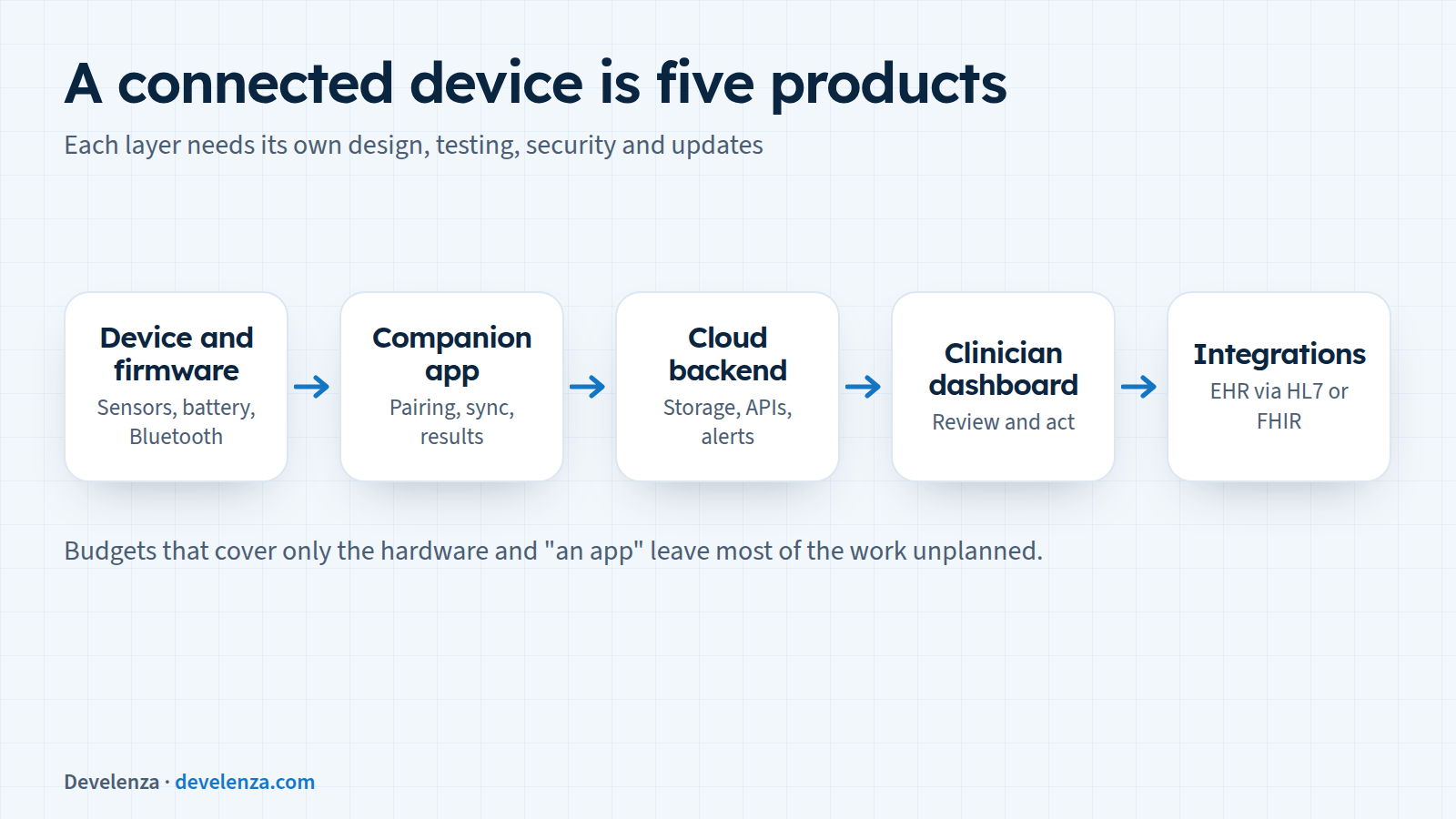
- Device and firmware. Sensors, battery, Bluetooth and the code running on the device.
- Mobile companion app. Pairing, syncing, showing results to the patient and sending data onwards.
- Cloud backend. Secure storage, APIs, alerts and user accounts.
- Clinician dashboard. Where care teams review data and act on it.
- Integrations. Getting data into the hospital's EHR, usually through HL7 or FHIR.
Each layer needs its own design, testing, security and updates. Budgets that only cover the hardware and "an app" leave most of the work unplanned.
Is your software a medical device?
This is the first question to answer, because it shapes everything that follows. If the software has a medical purpose, such as diagnosing, monitoring or treating, it may be a medical device itself, or part of one.
In the EU, the Medical Device Regulation (MDR) has a specific rule for software (Rule 11). Software that provides information used to make diagnostic or treatment decisions usually lands in Class IIa or higher, which means a notified body reviews it. In the US, the FDA has its own framework for device software functions. The intended use you write down decides the class, so write it carefully and early.
The standards you will meet
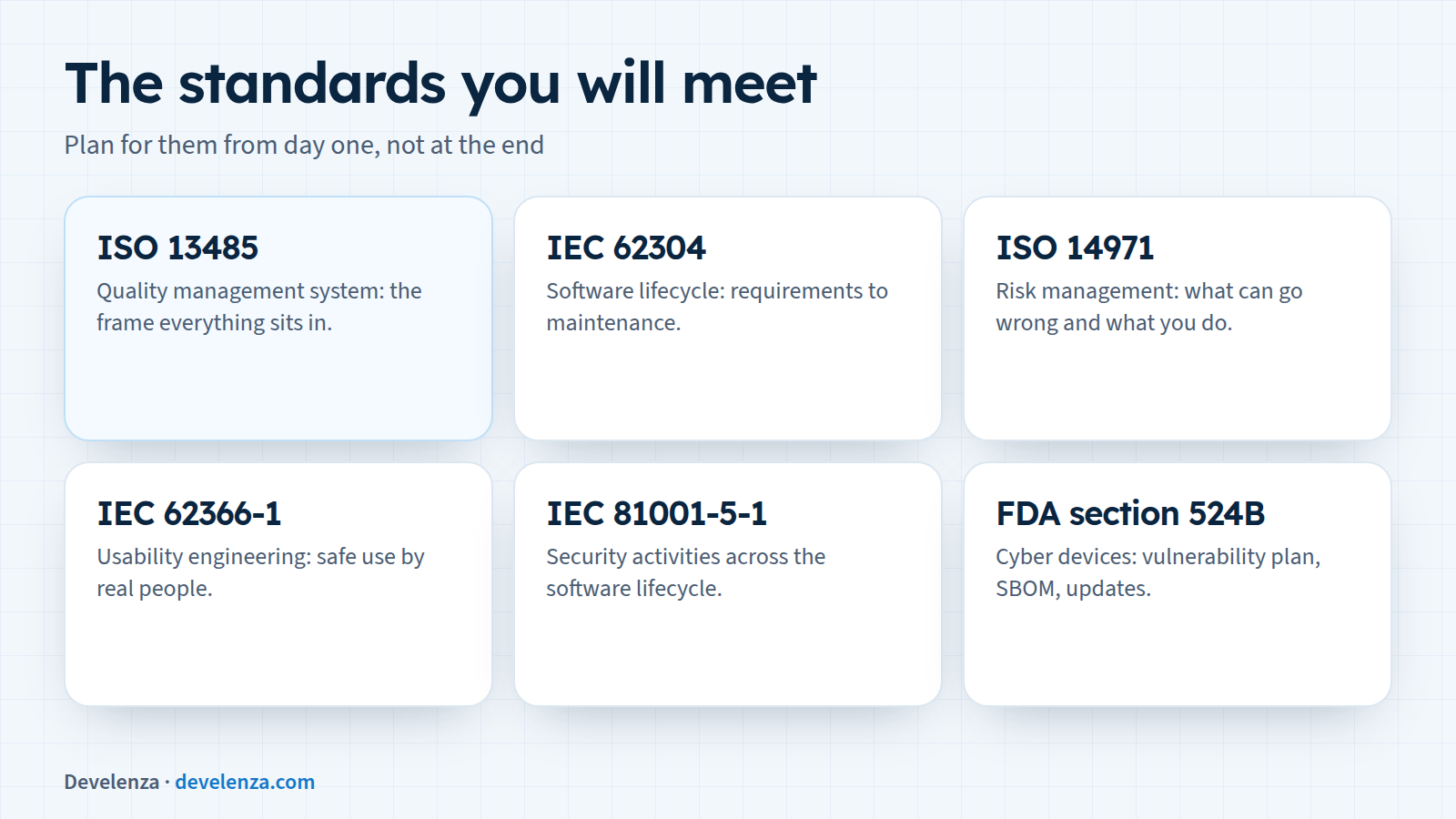
- ISO 13485: the quality management system the rest sits inside.
- IEC 62304: the software lifecycle, from requirements and architecture to testing and maintenance.
- ISO 14971: risk management. What can go wrong, how bad it would be, and what you do about it.
- IEC 62366-1: usability engineering, to show that people can use the device safely.
- IEC 81001-5-1: security activities across the health software lifecycle.
In the US, devices that connect to the internet and could be vulnerable count as "cyber devices" under section 524B of the Federal Food, Drug, and Cosmetic Act. Their submissions must include a plan for handling vulnerabilities, a software bill of materials (SBOM) and a way to ship security updates.
None of this has to slow a project down if it is planned from the start. Retrofitting it at the end is what hurts.
The costs that get forgotten
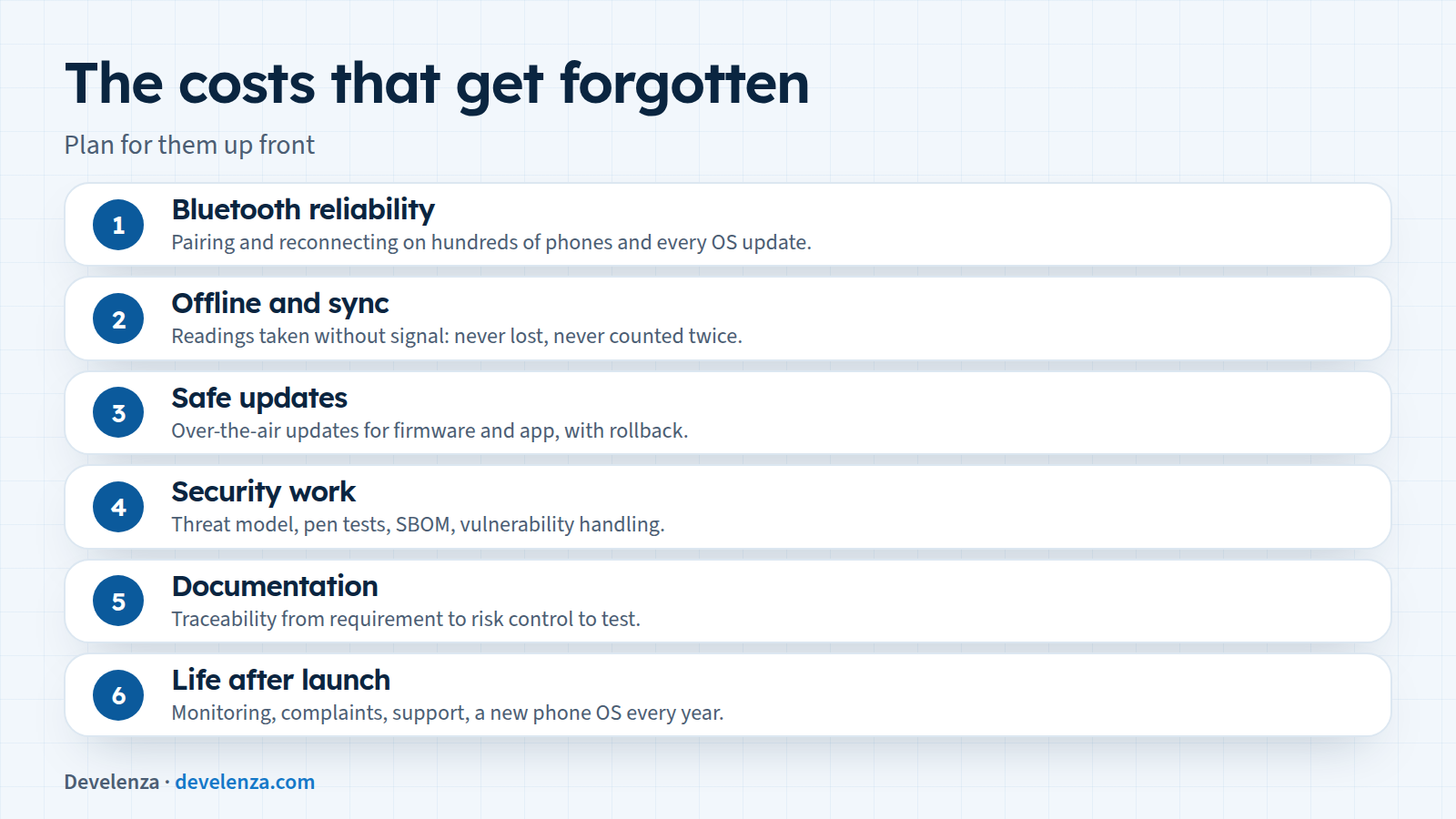
- Bluetooth reliability. Pairing and reconnecting across hundreds of phone models and every new version of iOS and Android.
- Offline and sync. Readings taken without a signal must not be lost or counted twice.
- Safe updates. Over-the-air updates for firmware and app, with a way to roll back.
- Security work. Threat modelling, penetration testing, an SBOM and a process for vulnerability reports.
- Documentation. Traceability from each requirement to its risk controls and tests, which IEC 62304 expects.
- Life after launch. Post-market monitoring, complaint handling, support, and a new phone operating system to test against every year.
Build it in the right order
- Write the intended use and agree the classification with a regulatory expert.
- Design the architecture with risk in mind. Decide where data lives, what happens when a link fails and how updates reach devices.
- Prototype the riskiest link first. Often that is Bluetooth plus offline sync, not the dashboard.
- Keep traceability from day one. Requirements, risks and tests linked in one place.
- Plan updates and monitoring before launch, not after the first support call.
Visiting MEDICA? Questions to ask a software partner
- Who maintains the app after launch, and how are new phone operating systems handled?
- Can you show how you document software under IEC 62304?
- How does the data reach the EHR, and in which format?
- What happens to readings when the phone is offline for a day?
How Develenza can help
We build the software around medical devices: companion apps, cloud backends, clinician dashboards and EHR integrations. We work alongside your regulatory consultant so the documentation grows with the code. Contact us to talk through your device, or start your project.
Sources
- MEDICA trade fair, Düsseldorf
- Regulation (EU) 2017/745 on medical devices (MDR)
- European Commission: MDCG guidance documents, including software qualification and classification
- FDA: Cybersecurity in Medical Devices Frequently Asked Questions
- FDA: Device Software Functions Including Mobile Medical Applications