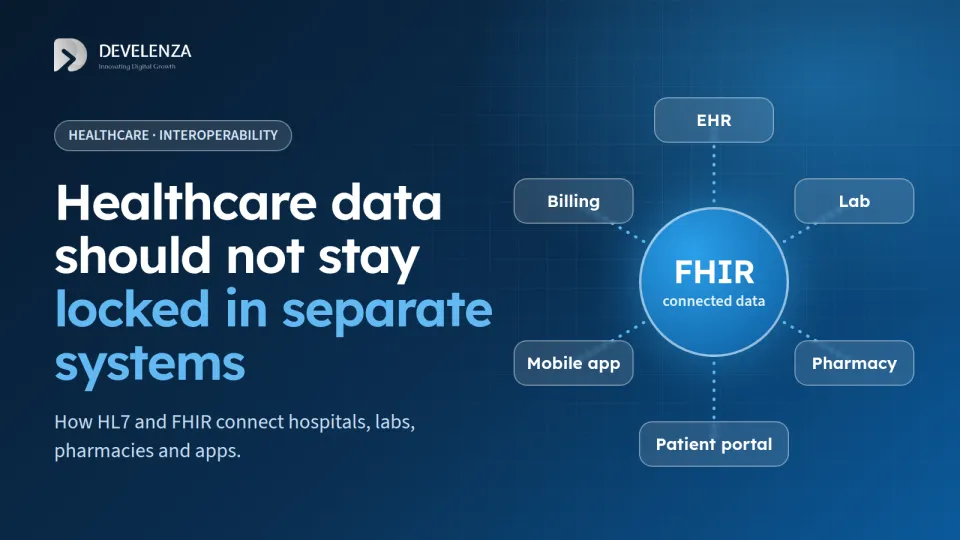
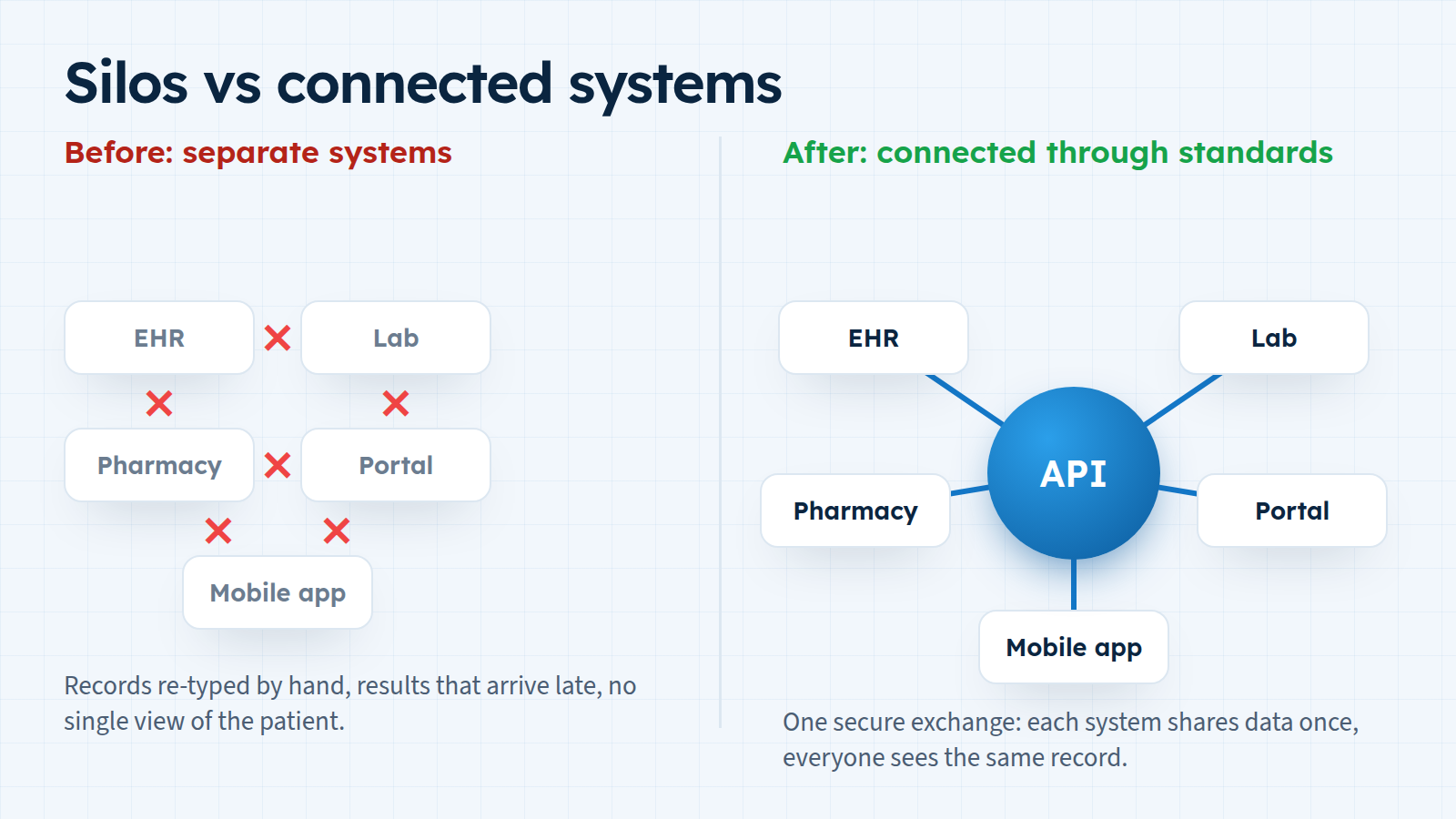
A patient's story is rarely stored in one place. The doctor's notes sit in the EHR, results in the lab system, prescriptions in the pharmacy, and appointments in a portal. When these systems cannot talk to each other, staff re-type data, results arrive late and nobody sees the whole picture. This is the problem of healthcare data silos, and standards such as HL7 and FHIR exist to solve it.
What separate systems cost
Silos rarely fail loudly. They cost a little every day:
- Time. Staff copy the same details between screens.
- Errors. Every manual copy is a chance for a typo in a name, dose or date.
- Delay. A result that is ready in the lab but not visible to the clinician is a result that waits.
- Missing context. Without a single view, decisions rely on partial information.
- Frustrated patients. Repeating the same history at every desk wears people down.
HL7 v2 and FHIR in plain words
HL7 v2 is the older messaging standard that most hospitals still use. Systems send short, pipe-delimited messages such as admissions and lab results. It works, but each connection tends to be custom.
FHIR (Fast Healthcare Interoperability Resources) is the modern approach. It exposes data such as patients, observations and medications through web APIs, in formats that developers already know. That makes it easier to feed portals and mobile apps.
You do not have to pick one. Most real projects use HL7 v2 where it already exists and FHIR for new interfaces.
Put an integration layer in the middle
Connecting every system directly to every other one creates a tangle that is hard to maintain. A better pattern is a single integration layer that translates and controls the data.
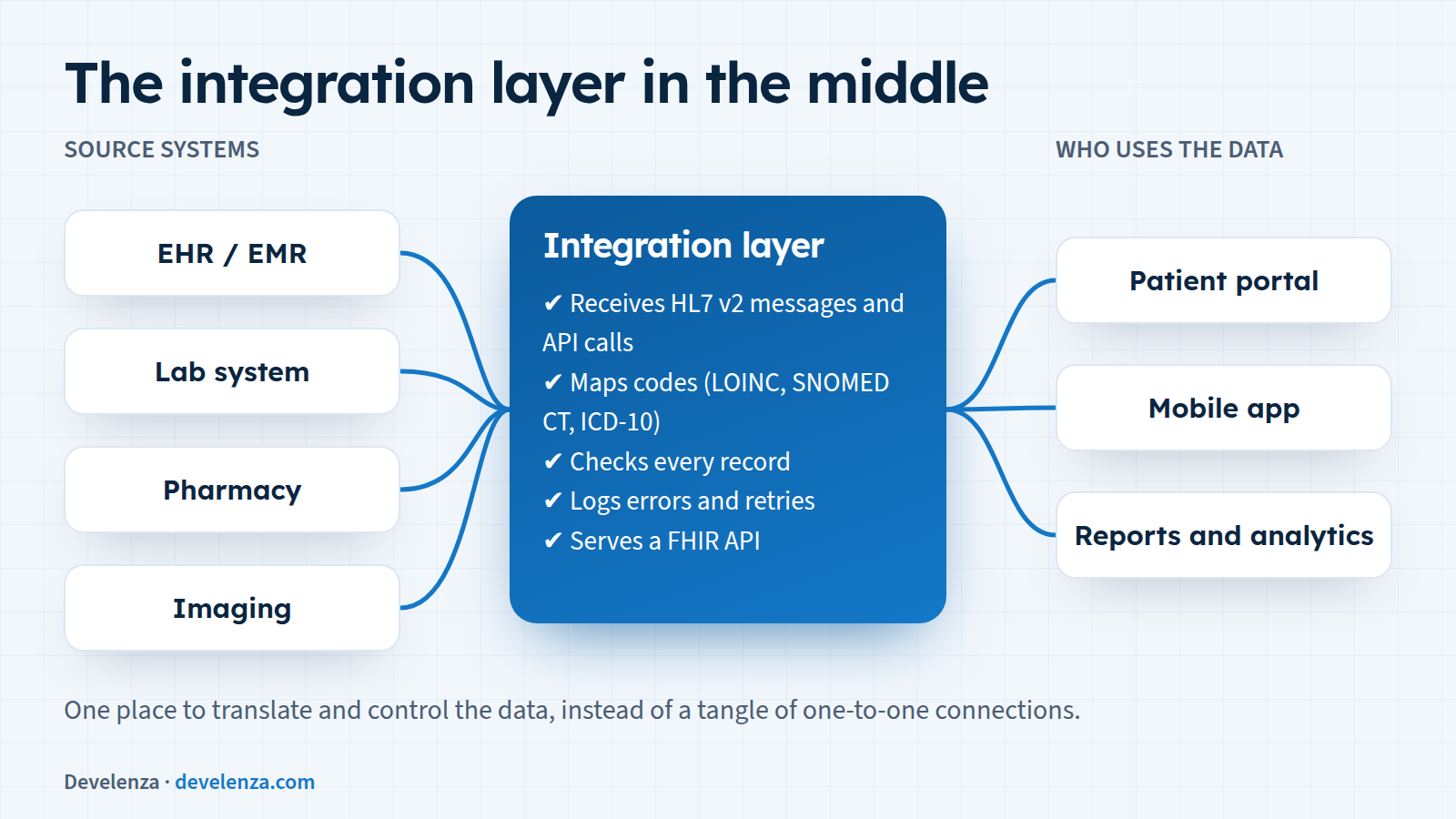
A good layer receives messages and API calls, maps codes (for example LOINC, SNOMED CT and ICD-10), checks each record, logs errors and retries, and serves a FHIR API to the apps that need the data.
Common pitfalls
- Trying to connect everything at once. Start small.
- Skipping data mapping. Two systems can both say "glucose" and mean different codes or units.
- No error handling. Messages fail. You need queues, retries and alerts.
- Testing with real patient data. Use realistic fake data in test environments.
- Ignoring the people. Clinicians and admin staff need to be part of the design.
Security and privacy come first
Health data is among the most sensitive data there is. Build in access control, encryption in transit and at rest, audit logs of who saw what, and the minimum data needed for each purpose. These are the safeguards that regulations such as HIPAA expect, but software alone does not make an organisation compliant. Policies, training and legal review are part of the job.
A step-by-step way to start
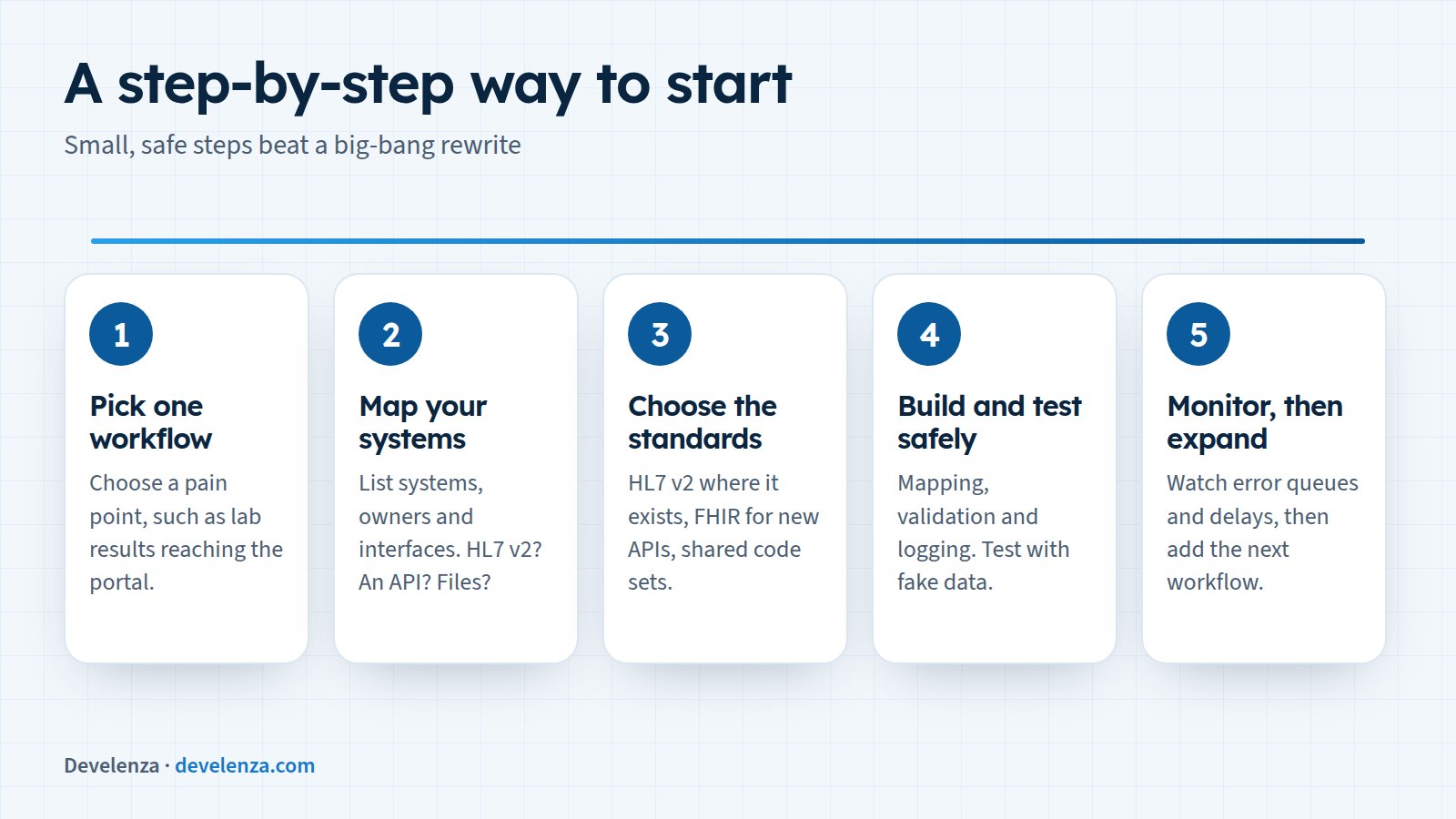
- Pick one workflow. Choose a real pain point, such as lab results reaching the patient portal.
- Map your systems. List each system, who owns it and how it exposes data: HL7 v2, an API or files.
- Choose the standards. HL7 v2 where it already exists, FHIR for new APIs, and shared code sets.
- Build and test safely. Mapping, validation and logging, tested with fake data.
- Monitor, then expand. Watch error queues and delays, then add the next workflow.
Small, safe steps beat a big-bang rewrite.
How Develenza can help
We build healthcare software and the connections between systems: HL7 and FHIR integrations, EHR and lab connections, patient portals and mobile apps. We start with one workflow, show you the result, and grow from there.
Ready to talk about it? Plan your project or contact us