



- Written by: Develenza
- June 8, 2026
- Categories: HealthCare
- Tags: , Healthcare Data
Healthcare Data Should Not Stay Locked in Separate Systems
Healthcare organizations generate vast amounts of valuable patient data every day. Yet much of that information remains trapped in disconnected systems, limiting its ability to improve care, efficiency, and patient outcomes.
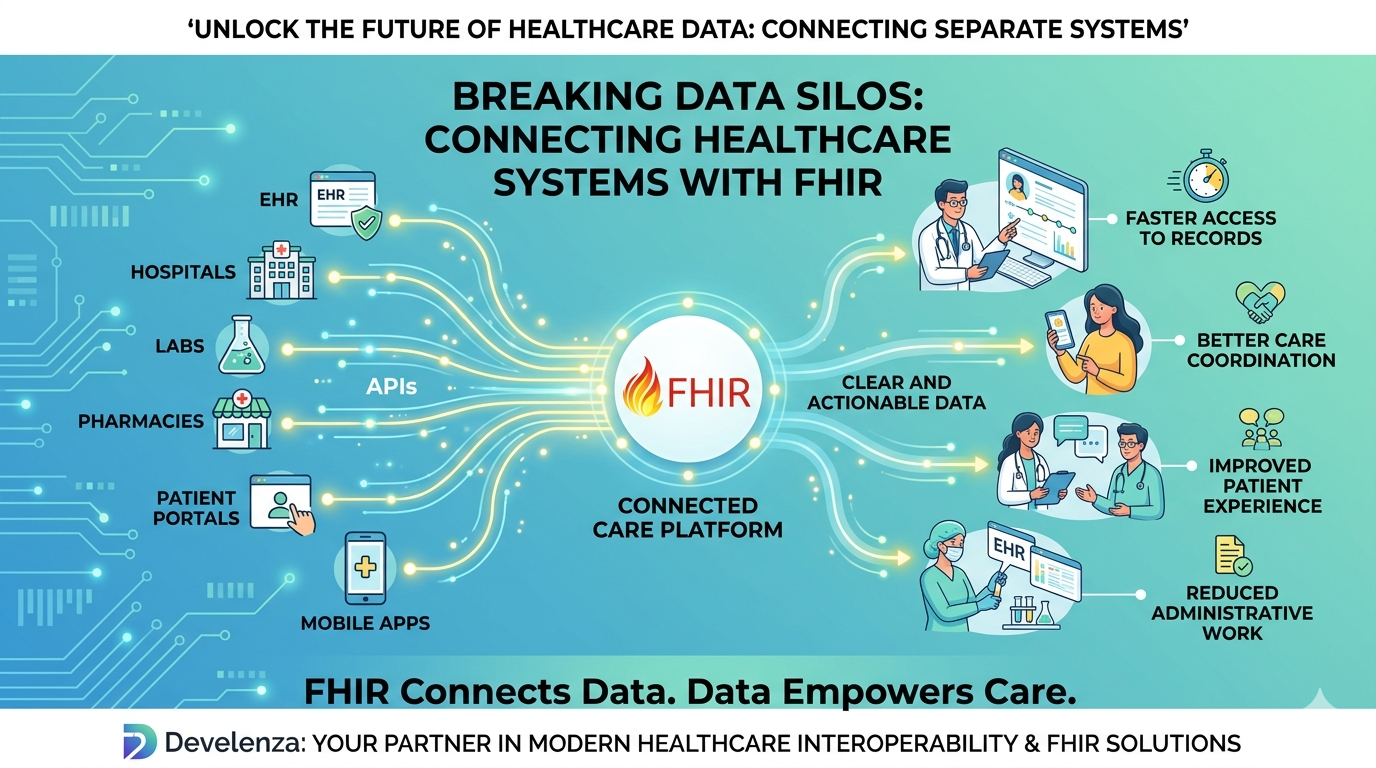
Hospitals, laboratories, pharmacies, Electronic Health Record (EHR) systems, patient portals, and healthcare mobile applications all create and store critical patient information. When these systems cannot communicate effectively, providers face incomplete records, duplicated work, delayed decisions, and fragmented patient experiences.
In modern healthcare, connected data is no longer a luxury—it is a necessity.
The Challenge of Healthcare Data Silos
Data silos occur when healthcare information is stored separately across multiple systems that cannot easily exchange information. These barriers reduce visibility, slow down workflows, and make it difficult to deliver coordinated care.
Why Healthcare Interoperability Matters
Healthcare interoperability allows systems to securely exchange, interpret, and use information regardless of the technology platform being used. This creates a seamless flow of information between healthcare stakeholders.
Faster Access
Healthcare professionals can access patient information quickly across multiple systems.
Better Care Coordination
Providers gain a complete view of patient history and treatment plans.
Improved Patient Experience
Patients can easily access and manage their healthcare information.
Reduced Administrative Work
Automation minimizes manual data entry and reduces errors.
How FHIR Connects Modern Healthcare Systems
FHIR (Fast Healthcare Interoperability Resources) has emerged as the leading standard for healthcare data exchange. It enables healthcare organizations to connect systems using modern APIs and standardized data structures.
With FHIR, hospitals, labs, pharmacies, EHR systems, mobile apps, and patient portals can connect smoothly, making healthcare data faster, smarter, and more accessible.
Rather than relying on complex custom integrations, healthcare organizations can use FHIR to create scalable and secure digital ecosystems that support innovation and growth.
“FHIR Connects Data. Data Empowers Care.”
Building Connected Healthcare Ecosystems with Develenza
At Develenza, we help healthcare organizations build modern interoperability solutions that unlock the true value of healthcare data.
Our team specializes in healthcare integrations, FHIR implementation, API development, EHR connectivity, patient engagement platforms, and digital health solutions that enable seamless information exchange across the healthcare ecosystem.
Whether you're a healthcare provider, health-tech startup, payer organization, or digital health platform, we can help you create secure, scalable, and future-ready healthcare solutions.
Ready to Build a Smarter Healthcare System?
Connect your healthcare systems, improve patient experiences, and unlock the full potential of your healthcare data with modern interoperability solutions.
Contact Develenza Today