Grand Theft Auto VI launches today, 19 November 2026, on PlayStation 5 and Xbox Series X|S. Take-Two says pre-orders reached "unprecedented levels", and the road to today went through four public dates. First came "Calendar 2025", then "Fall of Calendar 2025", then 26 May 2026, and finally 19 November 2026. You don't need to play games to learn from that. Anyone who has promised a launch date for a website, an app or a patient portal has faced the same questions. When do you commit to a date? When do you move it? How do you tell people? Below: how the date moved, what Rockstar Games and its parent company Take-Two said each time, and six lessons for software projects of any size.
Facts checked on 19 November 2026 against Take-Two Interactive's press releases filed with the US Securities and Exchange Commission (February 2024 to November 2026), Take-Two's November 2026 investor presentation and Rockstar Games' Newswire.
How the release date moved
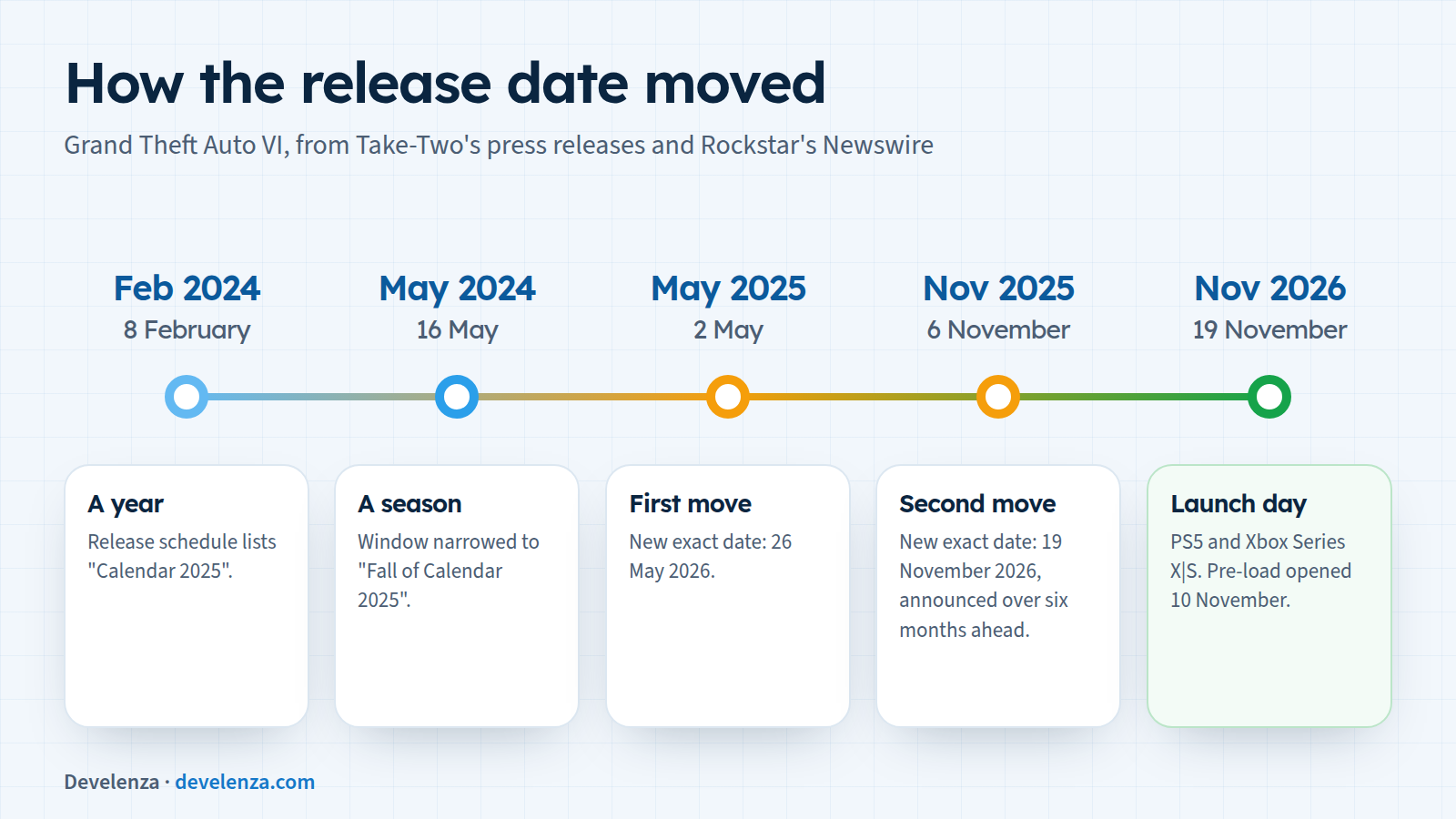
- 8 February 2024: Take-Two's release schedule lists Grand Theft Auto VI for PS5 and Xbox Series X|S in "Calendar 2025".
- 16 May 2024: Take-Two narrows Rockstar's window "of Calendar 2025 to Fall of Calendar 2025".
- 2 May 2025: Rockstar announces that the game, "which was expected to launch in Fall of 2025, is now planned for release on May 26, 2026".
- 6 November 2025: Rockstar posts on its Newswire: "Grand Theft Auto VI will now release on Thursday, November 19, 2026." Take-Two repeats the date in its results the same day.
- 9 November 2026: Take-Two's chief executive, Strauss Zelnick, says "the launch of Grand Theft Auto VI is ten days away", with pre-orders "continuing to reach unprecedented levels".
- 10 November 2026: pre-loading opens for digital pre-orders, nine days before launch.
- 19 November 2026: launch day.
The window got narrower before it moved: a year, then a season, then a specific day. Each move came with a new exact date, never a vague "later".
What they said each time
The announcements were short. Rockstar's note in November 2025 had three paragraphs. It gave the new date, apologised and gave the reason:
"We are sorry for adding additional time to what we realize has been a long wait, but these extra months will allow us to finish the game with the level of polish you have come to expect and deserve."
Take-Two backed the studio publicly. In May 2025 Zelnick said: "We support fully Rockstar Games taking additional time to realize their creative vision for Grand Theft Auto VI." He added that the company takes "the movement of our titles seriously".
The press release also shows what a date change touches beyond the team building the product. The May 2025 move put the launch "during the Company's Fiscal Year 2027" instead of fiscal 2026, so it moved the company's revenue plans with it. A release date is never just an engineering detail.
Six lessons for software release dates
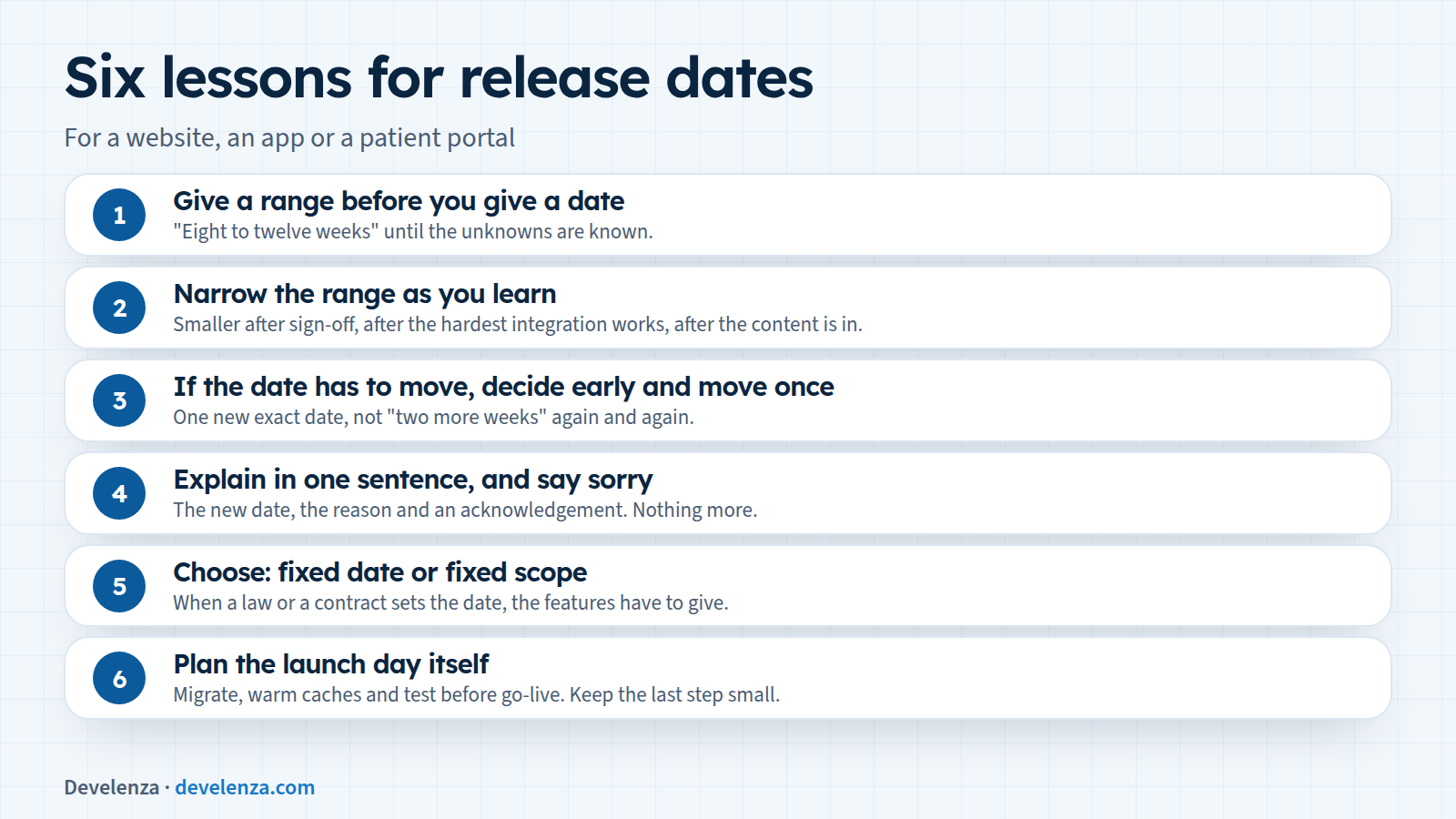
1. Give a range before you give a date
At the start of a project, nobody knows enough to name a day. The first public promise here was a year, "Calendar 2025". For a client project, that means saying "late spring" or "eight to twelve weeks" until the design is agreed and the unknowns are known: integrations, data migration, third-party approvals. A range is honest. An exact date given too early is a guess that people will treat as a promise.
2. Narrow the range as you learn
Three months after "Calendar 2025" came "Fall of Calendar 2025". Each stage of a project removes uncertainty. When the designs are signed off, when the hardest integration works on a test server, when the content is in, the range should get smaller. Share each step. Clients who have watched the range narrow are much more ready to hear the final date, and to believe it.
3. If the date has to move, decide early and move once
Rockstar announced the second delay on 6 November 2025, more than six months before the 26 May 2026 date it replaced. Each time, it gave one specific new date. Moving a date late, or in small steps of "two more weeks", costs more trust than one clear decision made early. When you can see that a milestone won't hold, say so as soon as you know, and give the new date with the reason.
4. Explain in one sentence, and say sorry
"These extra months will allow us to finish the game with the level of polish you have come to expect." That is the whole explanation. People affected by a delay want three things: the new date, the reason and an acknowledgement that the wait costs them something. They rarely want a long technical story. If you are moving the launch of a client's site, the same three things fit in a short email.
5. Choose: fixed date or fixed scope
Rockstar kept the scope and the quality bar, and moved the date. That's a choice, not the only option. Many software projects can't move: a campaign is booked, a contract ends, a regulation takes effect. Our post on the HTI-5 final rule covers health IT changes with fixed effective dates on 28 December 2026 and 1 January 2027. When the date can't move, the scope has to, so agree early which features can wait for a second release.
| If… | Then keep fixed… | And adjust… |
|---|---|---|
| A law, contract or event sets the date | The date | The scope: launch the essentials, add the rest after |
| Errors would harm users (health data, payments, prescriptions) | Quality and testing | The date, or the scope |
| The product only works with every part (a migration, an integration) | The scope | The date |
| Neither is fixed | Agree which one matters more before the work starts |
6. Plan the launch day itself
Rockstar opened pre-loading on 10 November, nine days before launch, so players could download the game in advance. Players who bought the boxed "code-in-box" version could activate their code and pre-load as soon as it arrived. Pre-loading lets players download in advance instead of all at the same moment on launch day. The same idea works for a website or an app: migrate the data and warm the caches before launch, test the forms on the live server, publish the app to the stores early, and keep the go-live step itself as small as you can.
Why it matters
A missed date is rarely what damages trust. The damage comes from a date that slips without warning, is moved more than once, or changes with no reason given. The Grand Theft Auto VI announcements followed a simple pattern: a range first, a firm date once the work was known, early warning when it had to move, one sentence of explanation and an apology. That pattern costs nothing and fits a two-month website project as well as a multi-year game.
For healthcare software, the trade-off in lesson 5 matters even more. A clinic can live with a booking system that launches a month late. It can't live with one that loses appointments. Decide what is fixed before the project starts, and write it down.
How Develenza can help
Planning a new website, app or healthcare system and need a launch date you can rely on? Start your project and tell us what has to be ready, and by when. We'll tell you what that date depends on. Already behind on a project and need a second opinion on what can still ship in time? Contact us.
Sources
- Rockstar Games Newswire: Grand Theft Auto VI is Now Set to Launch November 19, 2026 (6 November 2025)
- Rockstar Games Newswire: Pre-Load Grand Theft Auto VI Now (10 November 2026)
- Take-Two Interactive: results for fiscal third quarter 2024 (8 February 2024, release schedule "Calendar 2025")
- Take-Two Interactive: results for fiscal year 2024 (16 May 2024, "Fall of Calendar 2025")
- Take-Two Interactive: Rockstar Games announces release date for Grand Theft Auto VI of May 26, 2026 (2 May 2025)
- Take-Two Interactive: results for fiscal second quarter 2026 (6 November 2025, "Grand Theft Auto VI now launching November 19, 2026")
- Take-Two Interactive: results for fiscal second quarter 2027 (9 November 2026)