PHP and nginx both shipped security releases in the week of 16 November 2026, and most PHP websites run on one or both. On 19 November the PHP team released PHP 8.5.13, 8.4.28, 8.3.37 and 8.2.36 with up to 18 security fixes. PHP rates the most serious ones critical, with a CVSS score of 9.2. nginx released 1.30.7 and 1.31.9 on 18 November with ten fixes, then 1.30.8 and 1.31.10 on 23 November with one more. If your site runs PHP behind nginx, which is the usual setup for Laravel and WordPress on a VPS, you need to update both.
Facts checked on 26 November 2026 against php.net (the release announcements and the PHP 8 ChangeLog), PHP's security advisories on GitHub, and nginx's security advisories and CHANGES file. Details can change as more information is published, so confirm against the sources at the end.
November 2026 PHP and nginx Security Fixes?
PHP: 19 November
PHP 8.5.13 lists 18 security fixes and PHP 8.4.28 lists 14. Most are in parts of PHP that almost every site uses. Here are the four PHP rates critical (CVSS 4.0 score 9.2):
| CVE | What PHP calls it | When it applies |
|---|---|---|
| CVE-2026-129289 | PHP-FPM request smuggling through an unread HTTP request body | The web server reuses FastCGI connections to PHP-FPM (nginx fastcgi_keep_conn on, Apache enablereuse=on) |
| CVE-2026-126714 | Partially overwritten session files can lead to remote code execution | PHP's default files session handler, with untrusted data in sessions |
| CVE-2026-115560 | Session serializer mismatch can lead to remote code execution | Session upload progress is on, and two different session serializers share one session store |
| CVE-2026-129496 | Timezone cache use-after-free can lead to remote code execution | PHP writes a warning to its own error log file as a worker starts, for example because date.timezone is invalid |
PHP's pre-release notice of 18 November said: "The issues rated CRITICAL require either non-default configuration or uncommon setups." Keeping FastCGI connections open is a common performance tweak, and startup warnings in the error log often go unnoticed for years.
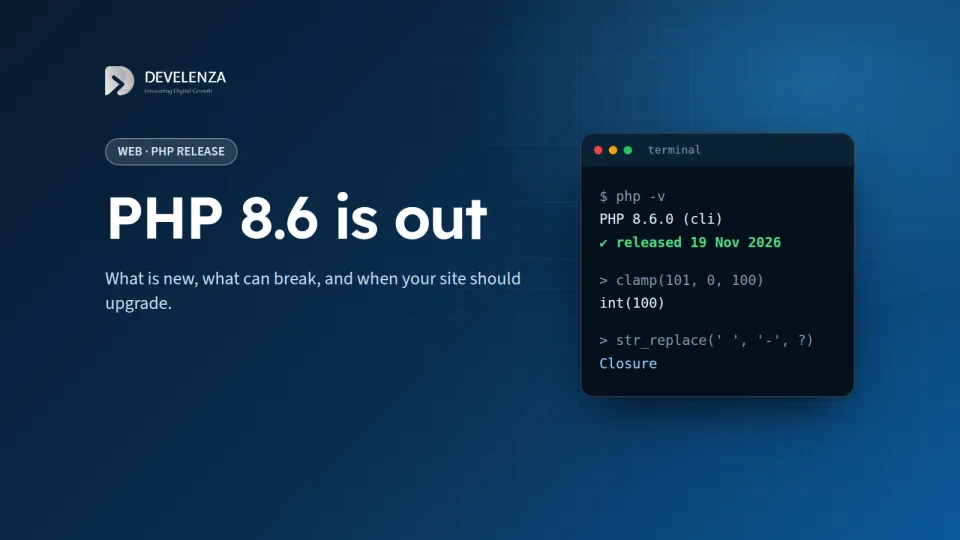
The other fixes cover PHP-CGI, the DOM, Phar, SOAP and URI extensions, a cross-site scripting bug on the PHP-FPM status page, and a bug where HTTPS:// and FTPS:// URLs written in mixed case could send data unencrypted. PHP 8.6.0, released the same day, includes the fixes. We are not describing how to exploit any of these.
nginx: 18 and 23 November
nginx 1.30.7 (stable) and 1.31.9 (mainline) fix ten flaws between them (one, in the PROXY protocol code, affects only the mainline branch). Two are in HTTP/2, one is in HTTP/3, and the rest are in the resolver, the mail proxy, the stream module, reading request bodies over TLS 1.3, the PROXY protocol, and alias used with try_files. nginx says the HTTP/2 flow-control flaw (CVE-2026-123007) can crash a worker process "or might have potential other impact". It affects every version from 1.9.5, which means almost every nginx server that has HTTP/2 turned on.
Five days later, nginx 1.30.8 and 1.31.10 fixed CVE-2026-132779, which lets a client cause high CPU usage when ssl_early_data is turned on. Versions 1.21.4 to 1.31.9 are affected, so 1.30.7 is not the end point.
nginx doesn't give these flaws a severity rating on its advisories page.
Which PHP and nginx Versions Are Vulnerable?
- PHP: every supported branch before the fixed release. PHP's advisories list everything below 8.2.36, 8.3.37, 8.4.28 and 8.5.13 as affected. PHP 8.1 and older get no fixes at all.
- nginx: stable versions before 1.30.8 and mainline versions before 1.31.10. Some of the flaws only matter if you use the module involved (HTTP/3, the mail proxy, the stream module), but the HTTP/2 flaws reach any server that has HTTP/2 turned on, which most HTTPS sites do.
- Distribution packages: Debian, Ubuntu, Red Hat and other distributions add fixes to their own version numbers instead of moving to the new release. Check your distribution's security tracker, not only the version number.
- Shared hosting: your host runs PHP and the web server. Ask them (step 6 below).
We found no report from PHP, nginx or CISA of these flaws being used in attacks as of 26 November. That is the reason to update now.
November 2026 Security Update Timeline
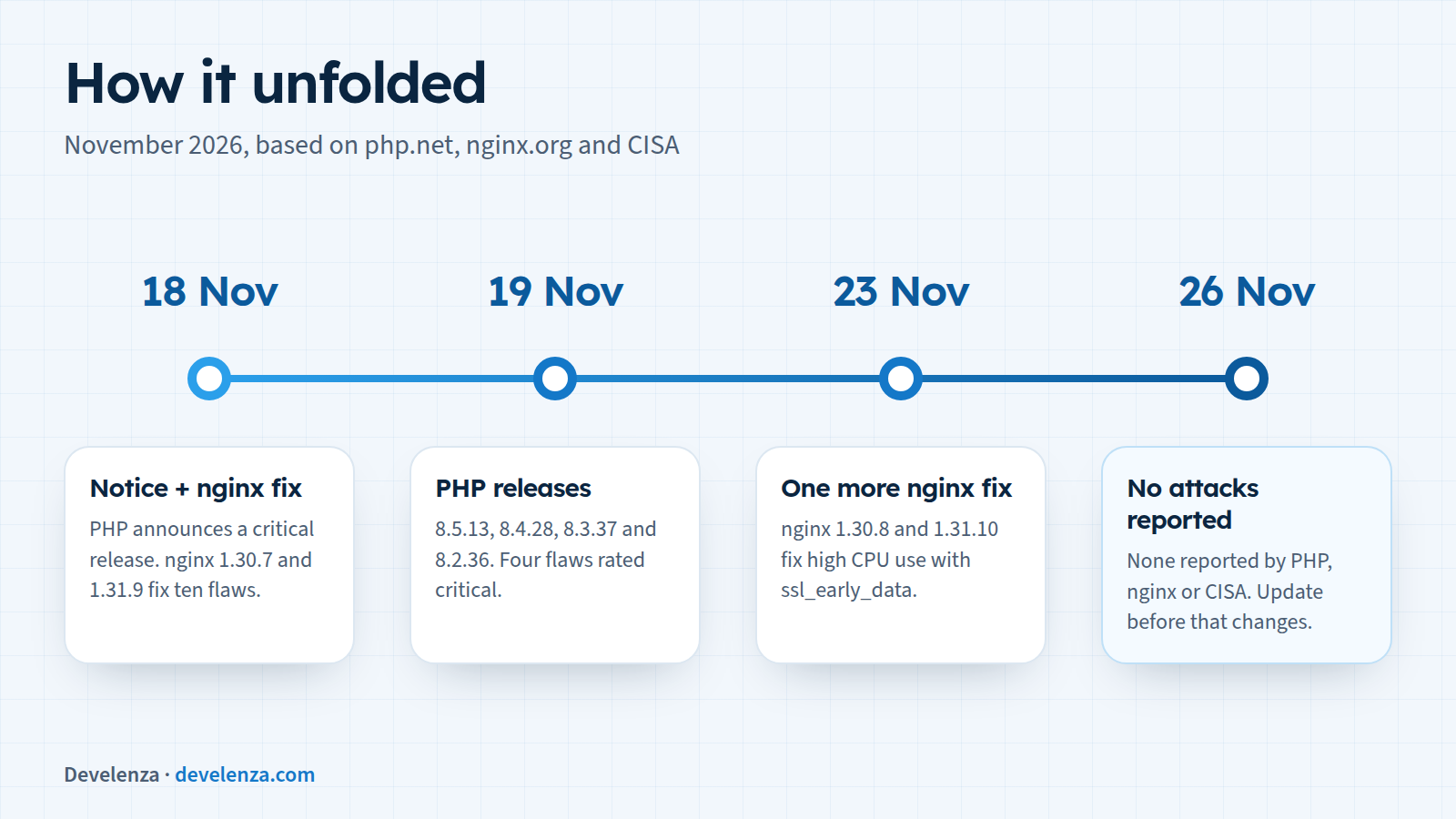
- 18 November: PHP announced an "Upcoming Critical PHP Security Release" for the next day, between 14:00 and 14:30 UTC. On the same day nginx released 1.30.7 and 1.31.9 with ten security fixes.
- 19 November: PHP released 8.5.13, 8.4.28, 8.3.37 and 8.2.36, published its advisories on GitHub, and released PHP 8.6.0.
- 23 November: nginx released 1.30.8 and 1.31.10, fixing the
ssl_early_dataCPU issue. - 26 November: we found no report of attacks from PHP, nginx or CISA.
Fixed PHP and nginx Versions
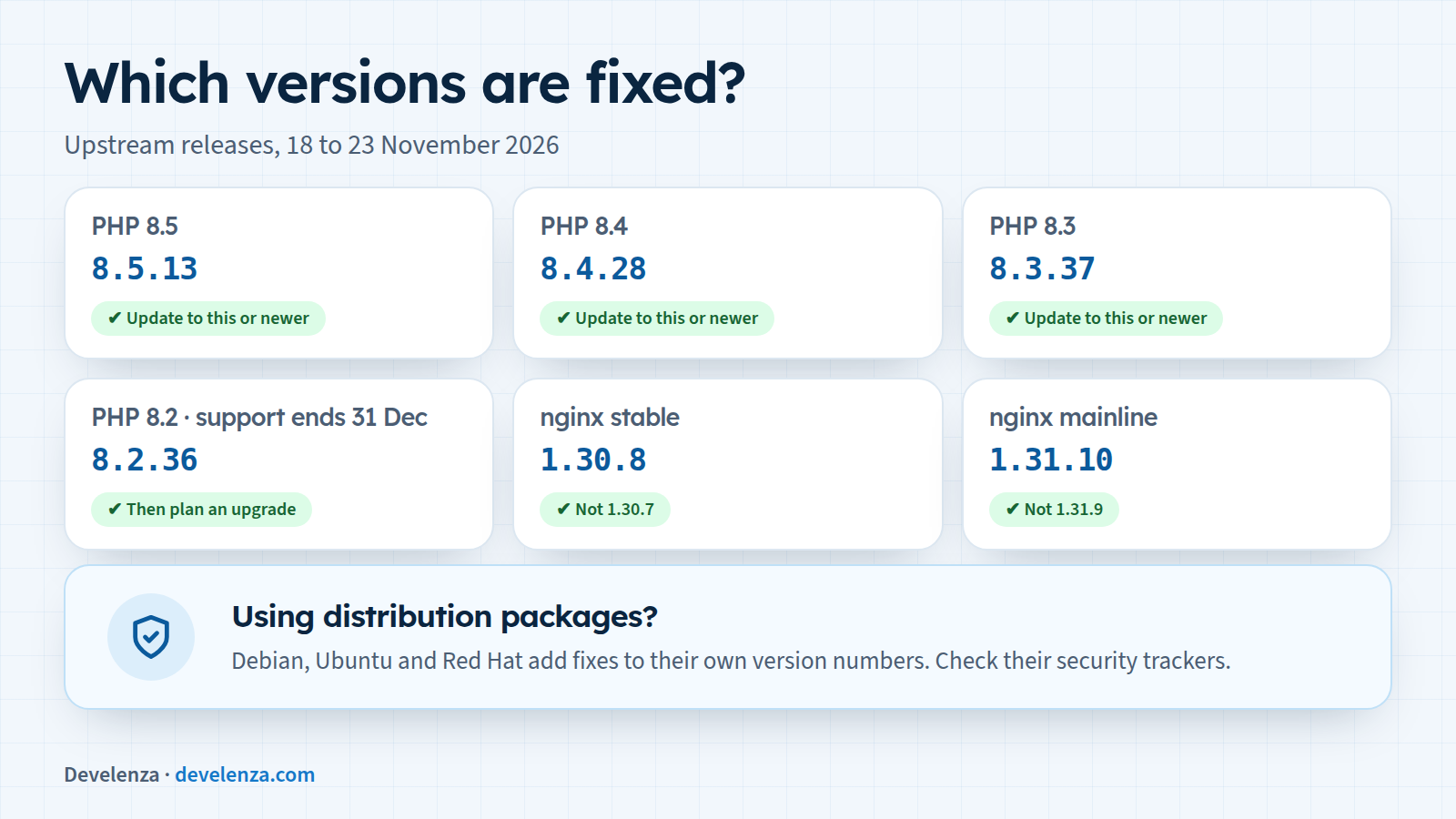
| Software | Branch | Update to |
|---|---|---|
| PHP | 8.5 | 8.5.13 or newer |
| PHP | 8.4 | 8.4.28 or newer |
| PHP | 8.3 | 8.3.37 or newer |
| PHP | 8.2 | 8.2.36 or newer (security support ends 31 December 2026) |
| PHP | 8.6 | 8.6.0 |
| nginx | stable | 1.30.8 or newer |
| nginx | mainline | 1.31.10 or newer |
If you use your distribution's packages, the fixed versions will have different numbers. Check the distribution's security tracker for the PHP and nginx CVEs above.
How to Secure Your PHP and nginx Server
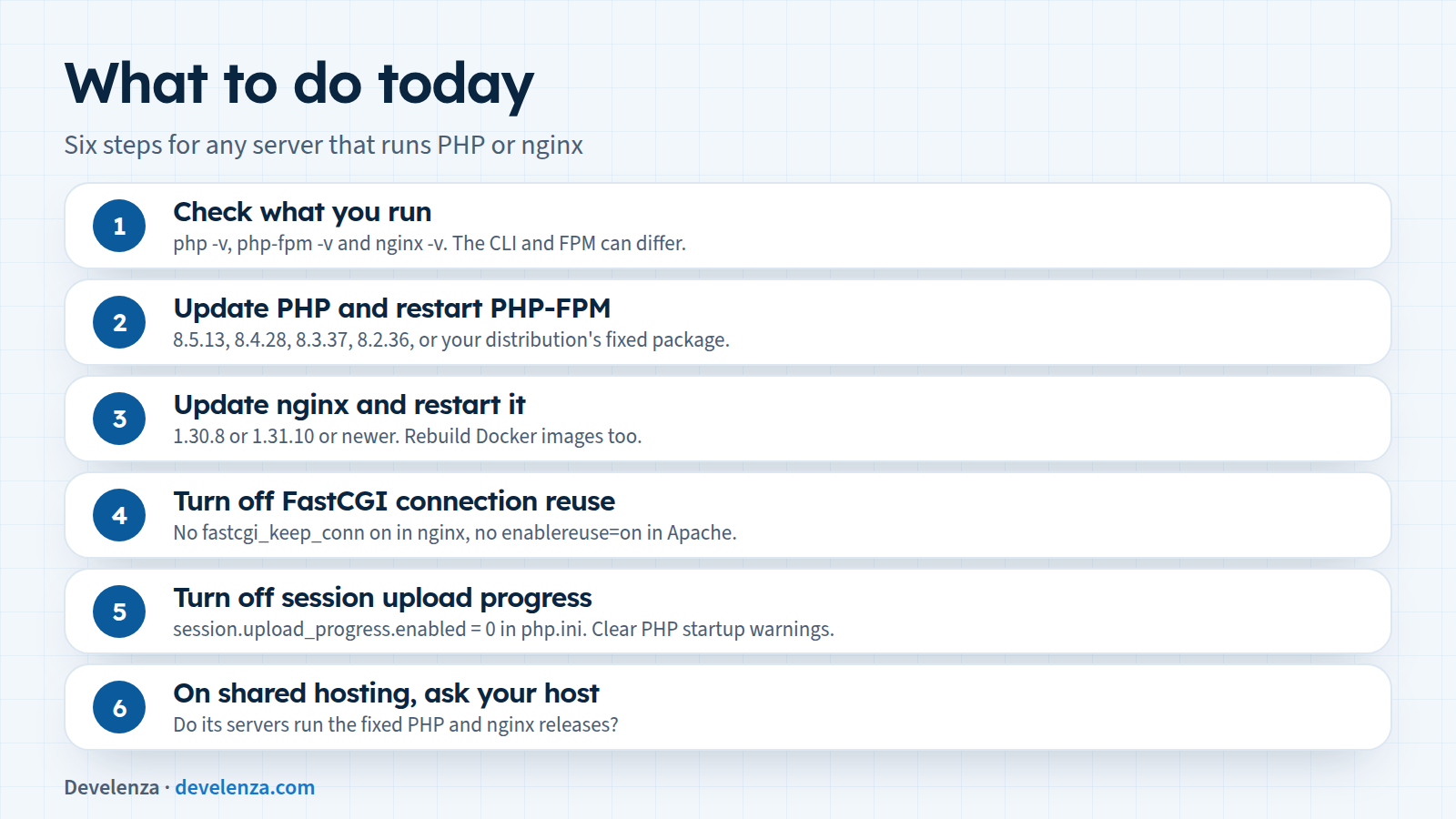
1. Check what you run
php -v
php-fpm8.4 -v        # or php-fpm -v, depending on how PHP was installed
nginx -v
The command-line PHP and PHP-FPM can be different versions, so check both. On Debian and Ubuntu, dpkg -l | grep -E 'php|nginx' lists the packages.
2. Update PHP and restart PHP-FPM
# Debian and Ubuntu (this upgrades all packages; the service name
# depends on your PHP version)
sudo apt update && sudo apt upgrade
sudo systemctl restart php8.4-fpm

# Red Hat, AlmaLinux, Rocky
sudo dnf update 'php*'
sudo systemctl restart php-fpm
: PHP-FPM keeps running the old code until it restarts.
3. Update nginx and restart it
# Debian and Ubuntu
sudo apt update && sudo apt install --only-upgrade nginx
sudo nginx -t && sudo systemctl restart nginx

# Red Hat, AlmaLinux, Rocky
sudo dnf update nginx
sudo nginx -t && sudo systemctl restart nginx
Run nginx -v afterwards. If you build Docker images that include PHP or nginx, rebuild them from fixed base images too.
4. Turn off FastCGI connection reuse
PHP's advisory for CVE-2026-129289 says to leave nginx's fastcgi_keep_conn and Apache's enablereuse turned off. Look for them:
sudo nginx -T 2>/dev/null | grep -n fastcgi_keep_conn
grep -rn enablereuse /etc/apache2/ /etc/httpd/ 2>/dev/null
If either is set to on, remove it, test the configuration and reload. The same advisory says never to expose PHP-FPM's listener (port 9000 or its socket) to an untrusted network.
5. Turn off session upload progress and clear startup warnings
PHP's advice for the two session flaws is to set this in php.ini (or the pool configuration), not with ini_set() in your code, which runs too late:
session.upload_progress.enabled = 0
Few sites use this feature. Laravel and most frameworks store sessions their own way, but upload progress is handled by PHP itself before your code runs, so set it anyway. Run php --ini to find the right file. FPM often uses a different php.ini from the command line.
For the timezone flaw, PHP advises fixing configuration errors that produce warnings as PHP starts, such as an invalid date.timezone or a deprecated setting. Look at the start of your PHP error log, fix what it reports, and restart PHP-FPM.
6. On shared hosting, Contact your hosting provider to confirm whether the security patches have been applied.
Ask which PHP and nginx versions or packages its servers run, and whether they include the November fixes. Many control panels let you choose the PHP version yourself. If yours does, pick a fixed release.
Why Full-Stack Server Security Matters
This is the second PHP security release in a month. PHP2Shell was fixed on 21 October. It follows the Apache HTTP/2 fix, SSHole and the Laravel 13.40 security fix. Each was in a different layer under the same website. Your app code can be perfect and still be exposed by the web server or the PHP version below it.
PHP 8.2 users have one more deadline. Security support ends on 31 December 2026, so 8.2.36 may be one of the last fixes that branch gets. Our PHP 8.6 post covers what moving up involves.
How Develenza Helps Secure Your Infrastructure
Keeping your website secure requires more than updating application code. Your PHP environment, nginx configuration, server packages, and hosting infrastructure all need regular maintenance.
At Develenza, we help businesses maintain secure, reliable, and high-performing websites and web applications. Our team can review your server configuration, identify outdated software, apply relevant security updates, and help establish a regular maintenance process.
Whether you're running a Laravel application, a WordPress website, or a custom PHP platform, proactive server maintenance can help reduce security risks and prevent avoidable downtime.
Need help securing your PHP and nginx environment? Contact Develenza to discuss your infrastructure and security requirements or Start your project.
Sources
- PHP news archive 2026 (18 November notice and 19 November releases)
- PHP 8.5.13 release announcement
- PHP 8 ChangeLog
- PHP advisory GHSA-qc49-hpvq-g2w6 (CVE-2026-129289)
- PHP advisory GHSA-fm2m-fjf5-v3cp (CVE-2026-126714)
- PHP advisory GHSA-658j-r8rw-q6mx (CVE-2026-115560)
- PHP advisory GHSA-gr4f-wgx5-jpfv (CVE-2026-129496)
- nginx security advisories
- nginx 1.30 CHANGES
- CISA Known Exploited Vulnerabilities catalog