Google has not banned AI-generated content. If you've seen claims this month that it had, here is what actually happened: Google finished its November 2026 core update on 24 November, preannounced a December core update the same day, and clarified an ads policy on AI impersonation on 11 November. None of these bans content because AI helped write it. Since its February 2023 guidance, Google's position has been the same: content made mainly to manipulate rankings is spam, and useful content is fine, however it was made. If your site uses AI tools, here is what to check before the December update.
Facts checked on 27 November 2026 against Google Search Central (the AI content guidance, the spam policies, the core updates page and the Search Central blog), Search Console Help (the Manual Actions report), the Google Search Status Dashboard and the Google Ads policy help centre. Google changes these pages without notice, so confirm against the sources at the end.
This post was researched and drafted with AI tools, fact-checked against the sources listed at the end, and reviewed by the Develenza team.
What happened in November?
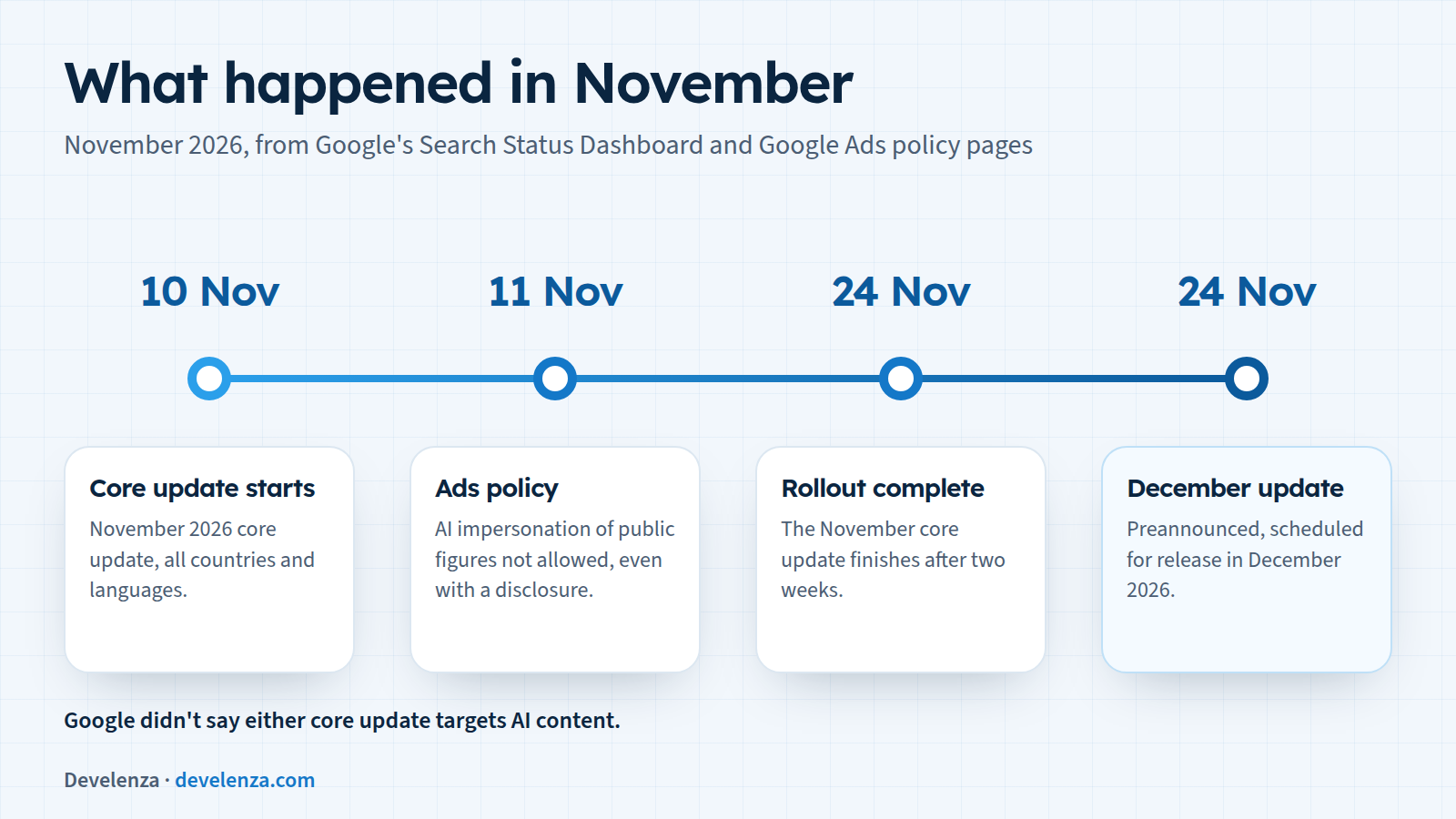
- 10 November: Google released the November 2026 core update, "which applies globally and to all languages". It said "The rollout may take up to 2 weeks to complete."
- 11 November: Google Ads updated its public-figure impersonation policy to say that "ads that impersonate public figures using AI are not allowed, even if they disclose that they were generated or edited using AI." Google says the clarification "does not change the enforcement of the policy."
- 24 November: "The rollout was complete as of November 24, 2026."
- 24 November: an hour later, Google "Preannounced the December 2026 core update". Google says it improves how its systems understand and rank relevant content, including for longer and more complex questions, and that "This update is scheduled to be released in December 2026."
Google did not publish a blog post about either core update, and it did not say that either one targets AI content. Its core updates page says these changes "are broad in nature, and don't target specific sites or individual web pages." Some SEO sites report that sites full of AI-generated pages lost traffic in November. Google has not confirmed this.
Does Google penalise AI content? What it actually says
Google's position has three parts, and all three are on its own pages.
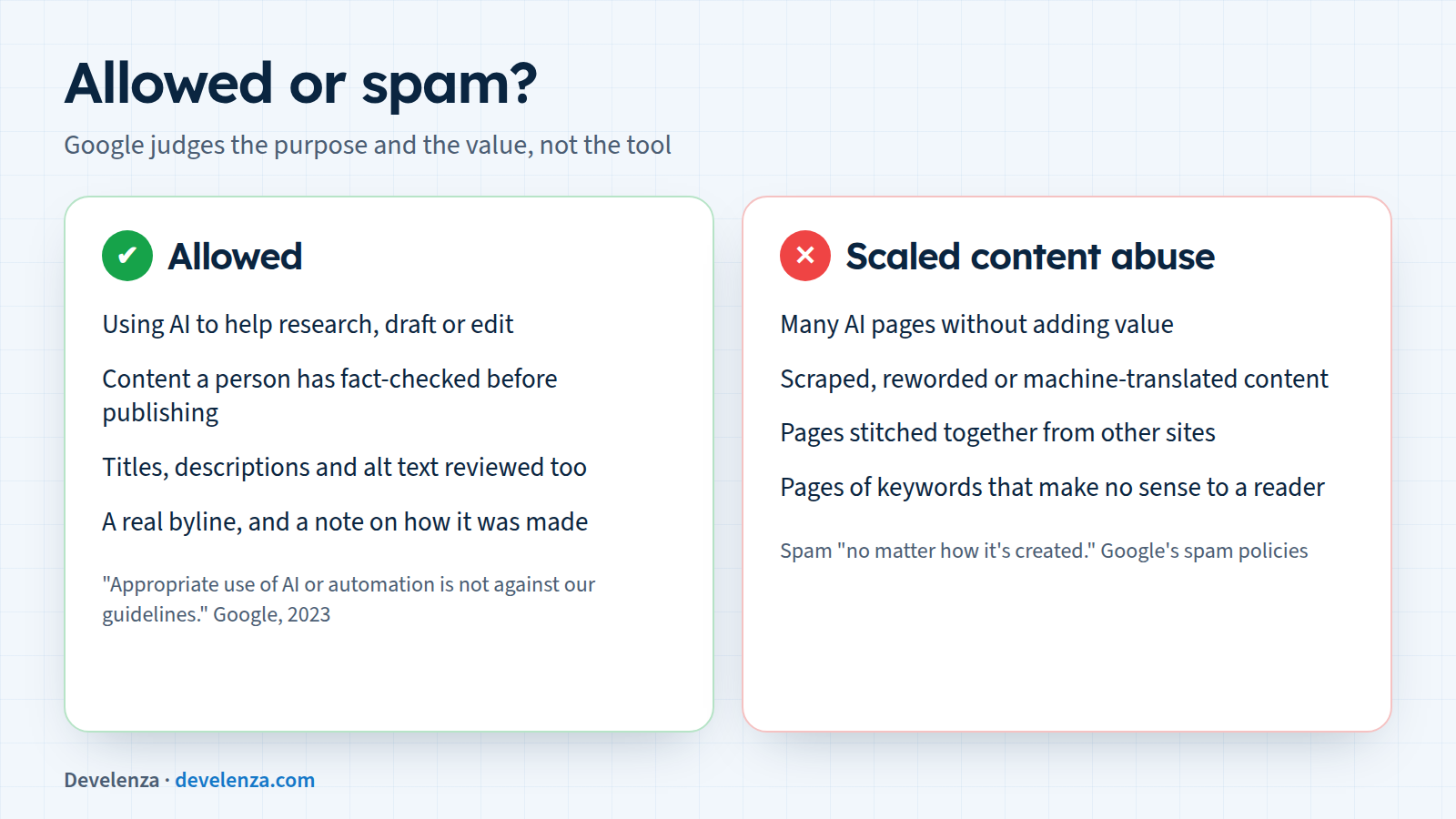
AI use is allowed. Google's guidance from 8 February 2023 still stands: "Appropriate use of AI or automation is not against our guidelines." The current page on generative AI content tells you to make sure your work "meets the standards of the Search Essentials and our spam policies", the same standard as any other content.
A person must check it. The same page says: "It is critical to manually factcheck and review all AI-generated content for accuracy and trustworthiness before publishing." It adds that "This review also applies to metadata like title elements, meta description elements, structured data, and alternate texts for images." It's easy to review the article and forget the page title, the meta description and the image alt text. Google names them.
Volume without value is spam. Google's spam policies define scaled content abuse as "when many pages are generated for the primary purpose of manipulating search rankings and not helping users", and say it applies "no matter how it's created."
What counts as scaled content abuse?
Google's spam policies give these examples, and say the list isn't complete:
| Google's example | What it looks like in practice |
|---|---|
| "Using generative AI tools or other similar tools to generate many pages without adding value for users" | Hundreds of near-identical "service in [city]" pages, or a blog that publishes 20 AI articles a day |
| "Scraping feeds, search results, or other content to generate many pages", including "synonymizing, translating, or other obfuscation techniques" | Other sites' articles reworded or machine-translated and published as new |
| "Stitching or combining content from different web pages without adding value" | "Ultimate guides" made by pasting together paragraphs from the top search results |
| "Creating multiple sites with the intent of hiding the scaled nature of the content" | A network of small sites carrying the same content |
| "Creating many pages where the content makes little or no sense to a reader but contains search keywords" | Pages written for keywords, not people |
Notice that the first example is about many pages without adding value, not about AI. One careful, fact-checked article written with AI help is not scaled content abuse. A thousand pages that nobody reviewed may well be, even if a person typed every one of them.
Do you have to disclose AI-generated content?
Google suggests it but doesn't require it. Its AI content page says to "consider adding information on how your content was created in a way that makes sense for your audience." Its guide to helpful content says "AI or automation disclosures are useful for content where someone might think "How was this created?""
The same guide is strict about who wrote the content. It warns against "Fabricating creator profiles (such as by using AI-generated headshots, made-up names, or false credentials". A real team byline is fine. An invented doctor with an AI-generated photo is not.
For appearing in AI features such as AI Overviews, Google published a separate guide to generative AI features in Search in May 2026.
What to do before the December update
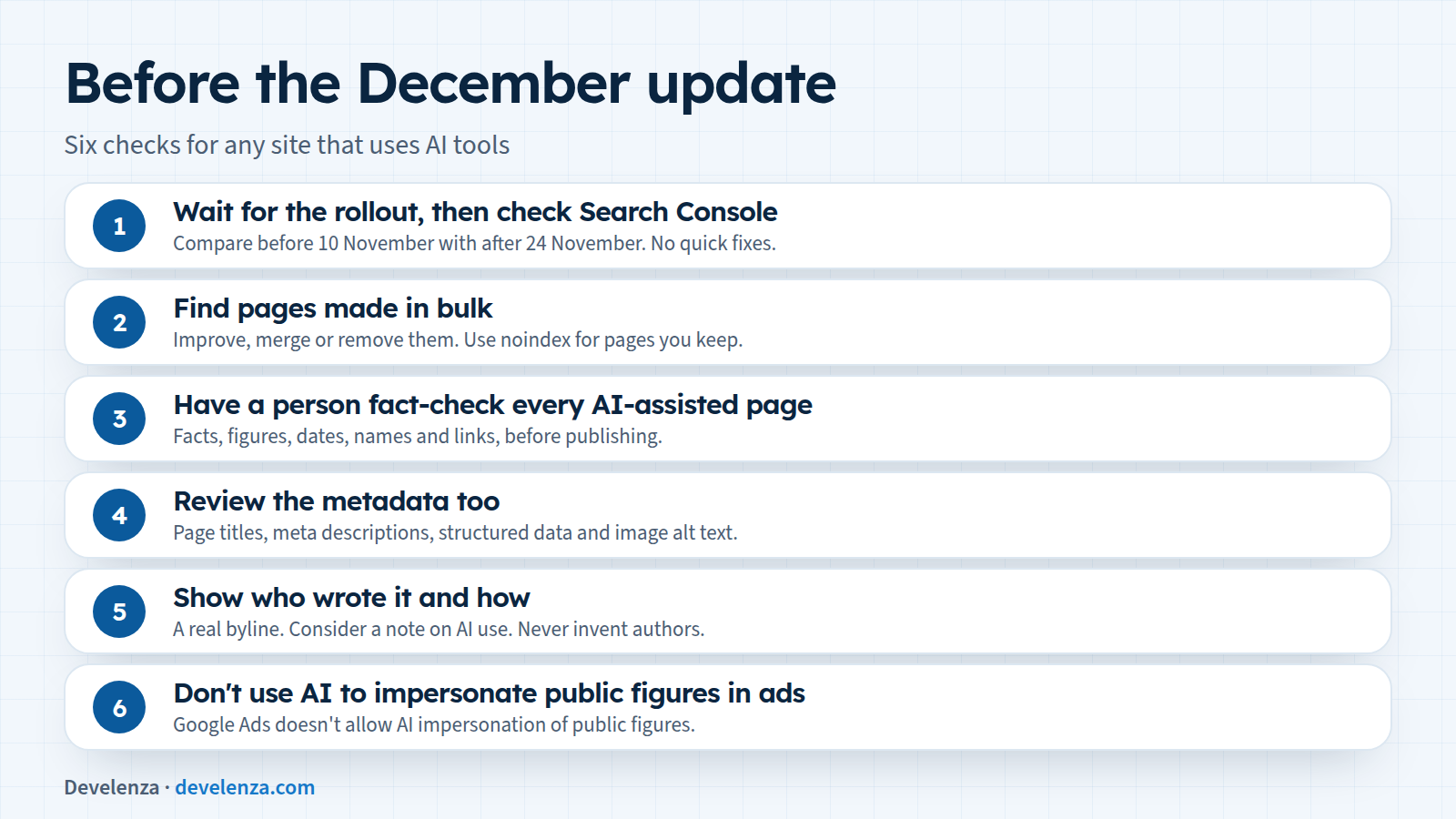
1. Wait for the rollout, then look at Search Console
Google's advice for core updates is to "Confirm that the core update has finished rolling out" before you judge the effect, and to "Avoid doing "quick fix" changes". The November update has finished, so you can compare the days since 24 November with the same length of time before 10 November in Search Console's Performance report. If traffic fell, Google suggests you "Evaluate the pages that were most impacted" against its questions for helpful content.
Also open the Manual actions report in Search Console. Google names scaled content abuse among the "aggressive spam techniques" behind its "Major spam problems" action, and it says that with a manual action, "some or all of that site will not be shown in Google search results." Once everything is fixed, you can use "Request Review".
2. Find pages made in bulk
List the pages that were generated from a template or by an AI tool in large numbers, such as location pages, tag pages and old auto-written articles. For each group, ask whether a visitor learns something they couldn't learn on the next page. Improve the best ones, merge the near-duplicates, and remove the rest. Google's spam policy says: "If you're hosting such content on your site, exclude it from Search." For a page you want to keep for visitors but not in Google, add a noindex tag to its <head>:
The page must stay crawlable for Google to see the tag, so don't also block it in robots.txt.
3. Have a person fact-check every AI-assisted page
Check each fact, figure, date, name and link against its original source before you publish, not after. This matters most for health, money and legal topics, where a wrong fact can hurt a reader.
4. Review the metadata too
Give the page title, meta description, structured data and image alt text the same fact-check as the article.
5. Show who wrote it and how
Put a real byline on articles. That can be a named person or your team. If AI helped, consider a short note such as "Researched with AI tools and checked by our team". Never invent authors, credentials or headshots.
6. Don't use AI to impersonate public figures in ads
If you advertise on Google, don't use AI to put a public figure in your ads, even with a disclosure label. Google's 11 November clarification says those ads are not allowed.
Why this matters for healthcare websites
Clinics, health-tech companies and patient services publish information that people act on: treatment pages, symptom guides, aftercare instructions. A wrong dosage or an outdated rule does more damage on a health site than on most others. Two patterns from the table above are worth checking first on a health site: one templated page per suburb or per condition, and symptom articles rewritten from other sites. Google asks for a person to check AI-assisted content, and patients would ask for the same. Our post on UX mistakes in healthcare software makes the same point about software: build for the people who use it.
How Develenza can help
If you're not sure which of your pages Google might see as made in bulk, we can check your site for templated and thin pages, look at Search Console's Manual actions report with you, and set up a review process for AI-assisted content. See our SEO and marketing services or contact us. Planning a new website or app? Start your project.
Sources
- Google Search Central: Using generative AI content
- Google Search Central: Spam policies (scaled content abuse)
- Google Search Central: Google Search's guidance about AI-generated content (8 February 2023)
- Google Search Central: Creating helpful, reliable, people-first content
- Google Search Central: Block search indexing with noindex
- Google Search Central: Core updates
- Google Search Console Help: Manual Actions report
- Google Search Central: Optimizing for generative AI features in Search (May 2026)
- Google Search Status Dashboard: November 2026 core update
- Google Search Status Dashboard: December 2026 core update
- Google Ads: Updates to Unacceptable Business Practices (November 2026)